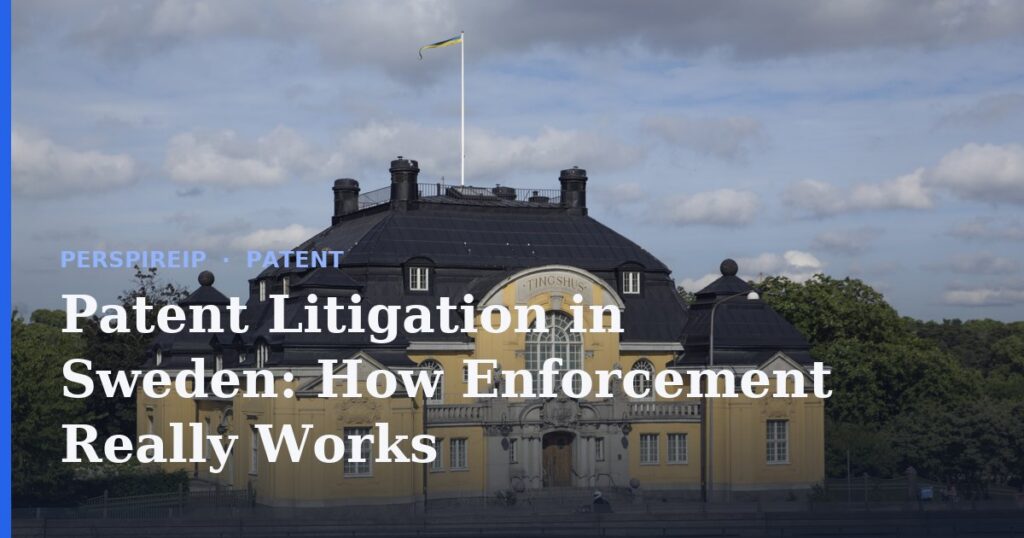
Patent Litigation in Sweden: How Enforcement Really Works
Where patent disputes are heard in Sweden, how invalidity is raised, what a case costs, and how the Nordic-Baltic UPC division changes the picture.
Read MorePerspireIP Blog
Expert perspectives on intellectual property strategy, patent law, trademark protection, and IP portfolio management from the PerspireIP team.
Where patent disputes are heard in Sweden, how invalidity is raised, what a case costs, and how the Nordic-Baltic UPC division changes the picture.
Read MoreA practitioner's 2026 guide to entering the PCT national phase in the United Kingdom — the 31-month deadline, the UKIPO route versus the European route, current fees, translation rules, and the late-entry lifeline.
Read MoreA practical, 2026-accurate guide to registering a trademark in Sweden through the PRV — the fees, the Nice classes, the examination the office runs, the three-month opposition window, and how to keep the mark alive.
Read MoreChina leads, IBM and Google top the corporates, the field is still unusually academic, and error correction is the new frontier — the quantum computing patent trends that matter in 2026.
Read MoreEight worked figure sets, the rule that governs each one, and the objection it is designed to avoid. What compliant patent figures actually look like, scenario by scenario.
Read MoreSolar still leads, wind climbs fastest, China has taken the lead and hydrogen is shifting to electrolysis — the renewable energy patent trends that matter in 2026.
Read MoreMost diligence decks count patents. The figures tell you whether those patents are worth counting. Seven checks a reviewer can run in an afternoon.
Read MoreA practical online enforcement playbook for brand owners: register your trademark, use marketplace takedown portals, record with customs, and monitor sellers to stop fakes.
Read MoreA route-by-route guide to filing a Swedish patent, a national PRV filing, a validated European patent, or the PCT national phase, with the fees, language rules, deadlines and courts that matter.
Read MoreAn international registration runs on two clocks that never align: WIPO's and the designated office's. Here are the nine dates a docket has to compute separately, and the field each one is measured from.
Read MoreBattery patent filings are growing several times faster than the patent system around them. Here is what the 2024-2025 data reveals about where EV cell innovation is heading.
Read MoreReference characters are the smallest thing in a patent figure and the most common reason a drawing comes back objected to. Here are the seven rules that decide it.
Read MoreA step-by-step, 2026-accurate guide to registering a trademark in France through the INPI — the fees, the classes, the examination the office does (and the one it does not), and how to keep the mark alive.
Read MoreHow to make a granted European patent take effect in Sweden — the translation you owe the PRV, the three-month clock, the fees, and whether to take the classical or Unitary route.
Read MoreA practical 2026 guide to validating a European patent in the Netherlands - the short claims-translation window, the modest fees, renewal costs, and how the right is enforced at The Hague and the UPC.
Read MoreA 2026 guide to patent litigation in France - the Paris court's exclusive jurisdiction, non-bifurcated trials, the saisie-contrefacon seizure, the UPC's Paris seat, and realistic timelines and costs.
Read MorePhotographs are the exception in patent practice, not the default. Here are the seven rules that decide whether yours will be accepted at the USPTO, the EPO and under the PCT.
Read MoreA 2026 guide to trademark registration in Germany - the DPMA national route, the EU and Madrid alternatives, current fees, the opposition-only examination, and how to keep a mark alive.
Read MoreA 2026 guide to trademark registration in United States - the use-based system, the new flat USPTO fee, the examination-to-registration timeline, and how to keep a mark alive.
Read MoreA practical guide to validating a European patent in France - why no translation is needed, what you pay INPI, and whether the UPC or the Paris court hears a dispute.
Read MoreLet our experts help you develop a comprehensive IP strategy tailored to your business needs.
Get Started Today